
The 18-month wedding timeline
Read dependencies before dates · 18 to 16 months: agree on the foundation · 16 to 14 months: test the setting · 14 to 12 months: assemble the key team · 12 to 10 months: guest and travel foundations

Planning companions · Couples
An 18-page planning timeline and decision ledger
A little order, a little more presence
A checklist can tell you what to do and still leave you unsure what comes first. Build a sequence around the decisions that affect one another, your actual agreements and the experience you want.
A working planning timeline with dependencies, handoffs and a final decision ledger.
18 designed pages · complimentary resource
A working planning timeline with dependencies, handoffs and a final decision ledger. Each chapter combines a practical conversation, a short action list and space for your own decisions.
Receive the guide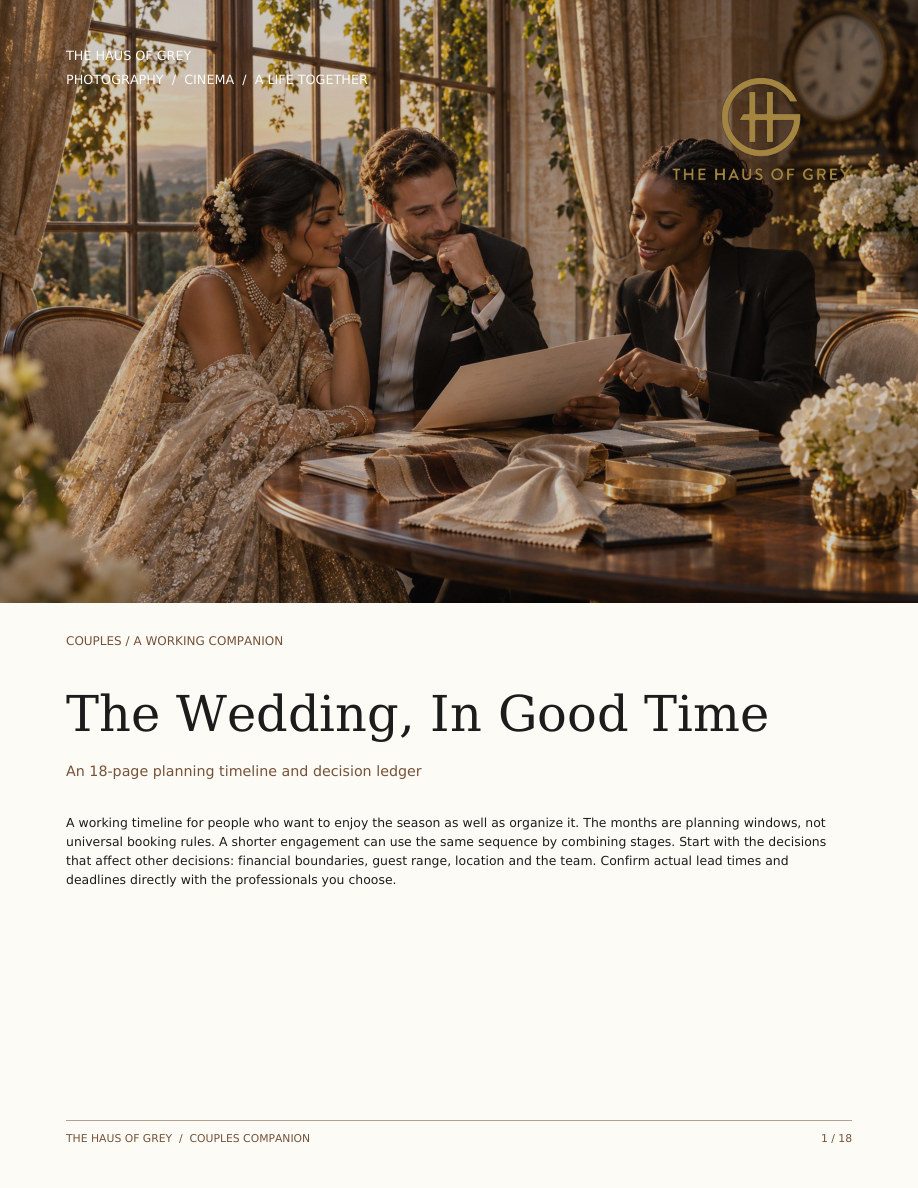
A considered working document
The guide is made to be used. Keep the pages that match your stage, write down what you decide and share only what each collaborator needs.
Read dependencies before dates · 18 to 16 months: agree on the foundation · 16 to 14 months: test the setting · 14 to 12 months: assemble the key team · 12 to 10 months: guest and travel foundations
8 to 6 months: ceremony and hospitality · 6 to 4 months: build the visual plan · 4 to 3 months: close production gaps · 3 to 2 months: make information usable · 8 to 6 weeks: the integration meeting
4 to 2 weeks: check the fallback · The final week: issue one packet · The day: follow the people · After the celebration: keep what remains · Your milestone ledger
A companion that earns its place
You do not have to finish every page before it becomes useful.
Begin by writing down what you already know and which decision is creating the most uncertainty. Work through the matching chapter, then choose a small next action with a person responsible and a sensible date. A plan becomes easier to use when it makes the next step clear.
Keep a working copy for yourself. Share only the pages that a planner, venue, visual team or other collaborator needs for their part of the work. Personal finances, family circumstances and private contact details do not belong in a widely circulated planning document.
Come back when a date, supplier, location or priority changes. Update the current version and retire old copies so the people helping you are working from the same information. The guide is a framework for your actual circumstances, rather than a promise that every celebration should look alike.
A closer look at the working pages
A venue affects access and the guest circle. A guest circle affects hospitality and transport. A cultural ceremony may affect clothing, the number of days and the visual team. Draw those relationships before copying a checklist into your calendar. A task belongs early when another important task depends on it, not merely because a generic list puts it in a particular month.
A useful next action: List decisions with downstream effects.
Review power, sound, lighting, deliveries and setup with the relevant professionals. Confirm which vendor handles each technical task. Revisit the weather alternative as a complete event, including guest movement and the visual plan. Reconcile payments and deadlines against the signed agreements, not a remembered estimate.
A useful next action: Review production with responsible vendors.
Check the delivery instructions and expected windows in your agreements. Save supplied masters in independent secure locations and note any gallery access deadline. Begin an album conversation when you are ready to edit the story into a physical form. Revisit your archive once a year. A timeline is complete when the work is received and kept, not simply when the last guest leaves.
A useful next action: Record delivery expectations.
These examples describe the guide’s approach. The complete workbook is provided through the name-and-email request form on this page.
Made for the people involved
There is no single family structure, language, budget or cultural tradition behind a meaningful celebration. Write in the names, relationships, observances and access needs that matter to your people. If a suggested prompt does not fit, replace it with a better question.
Use the companion alongside the current agreements and guidance from the professionals you choose. Confirm legal requirements, local rules, production access and supplier terms with the responsible person. A useful planning resource helps you ask informed questions; it cannot confirm someone else’s availability or responsibilities.
You are welcome to use the resource without booking a studio commission. If the visual approach feels right, the next-step page explains how to begin an individual conversation with The Haus of Grey. A resource request does not hold a date or place an order.

The world of the Haus
Use the companion at your current stage. Record what is known, identify the open decision and choose one practical next action with the person responsible for it.
Receive your companion
The world of the Haus
Use the companion at your current stage. Record what is known, identify the open decision and choose one practical next action with the person responsible for it.
Receive your companionThe working companion
A checklist can give you a hundred tasks while leaving the important question unanswered: what needs to be decided before you can decide anything else? The Wedding, In Good Time begins with that relationship. Its 18 pages offer a planning timeline and decision ledger that carries the work from the first foundation through delivery after the celebration.
The guide uses an 18-month sequence to show which kinds of work belong together. Month ranges are planning windows, while actual deadlines come from your circumstances, chosen professionals and signed agreements. A shorter engagement can combine stages while keeping the order of decisions that depend on one another. There is no need to complete earlier windows as an exercise when their purpose has already been met.
Financial boundaries, the guest circle and location create a foundation for the team, ceremony, hospitality and visual plan. Later pages bring those strands into an integration meeting, final packet and practical handoff. The aim is to organize attention across a season that also contains work, family and ordinary life.
The working companion
With ample time, distinguish decisions that unlock the plan from choices that can wait. Early clarity about the guest range or venue may be useful; early certainty about every small detail can create revisions. Give the foundation enough attention, then let later choices develop with the information and people they need.
Use the same dependency sequence inside a smaller calendar. Establish the place, practical boundaries and essential team before elaborating the design. Ask providers for actual lead times immediately and identify what can be simplified. Combining stages thoughtfully is different from expecting several dependent decisions to happen independently at the same moment.
The milestone ledger makes ownership visible without turning the relationship into a status meeting. Agree who carries each action, where the current answer lives and when to review it. Family contributors and planners can join relevant conversations while the two of you retain a common view of the priorities and decisions already made.
The working companion
Venue access affects preparation. Guest numbers affect hospitality and transport. A cultural ceremony may affect clothing, translation and visual coverage. Seeing those links helps you ask an important question before another commitment rests on an assumption. Place each task by its consequence as well as the date you hope to finish it.
A deadline becomes useful when you know whether it comes from a contract, production process or your own preference. Record its source and owner beside the action. If circumstances change, you can check with the responsible person instead of treating an anonymous online month marker as a rule for your particular event.
The later pages gather the timeline, contacts, access details, portrait groups and fallbacks into a current set. Key collaborators receive the information relevant to their work and acknowledge material changes. The final week can then focus on closing questions, preparing personal items and giving routine arrival matters to someone other than the couple.
The working companion
The early windows move from shared priorities and realistic boundaries to testing the setting and assembling date-dependent collaborators. The middle chapters consider guest travel, clothing, design, ceremony and hospitality. These subjects are connected: a garment may need a particular dressing space, while a family observance may influence the number of events or the way people move between them.
The later windows build the visual plan, close technical gaps and bring the leads together. Final lists, approvals and fallback checks become a packet that can be used under pressure. The closing pages address the day itself, delivery and a milestone ledger you can adapt. These previews describe the route; the complete working resource remains behind the name-and-email request.
The working companion
Imagine a couple planning a family-led ritual followed by dinner in another room. They initially place portraits between ceremony and reception because an online schedule does so. A conversation reveals additional dressing time, translation and a pause with family. The venue also has a fixed catering access period. The proposed portrait interval overlaps several commitments that the sample schedule could not know.
The couple traces the order with the people doing the work. The officiant and family lead confirm the ritual. The planner checks access and guest movement. The photographer explains which essential groups can be made nearby and what an earlier portrait option requires. The couple chooses a sequence protecting the ceremony and dinner, then records optional photographs that can be simplified.
This is a hypothetical planning example, not a client timetable. The schedule improves because real dependencies are confirmed. The revised time reaches affected leads through the current packet, rather than remaining a private note everyone else must discover on the day. Another celebration may arrive at another order for equally considered reasons.
The working companion
In the foundation windows, discuss financial room, the guest circle and dates important to your families, faiths and working lives. A guest range can guide research before every invitation is settled, but record the assumptions behind it. If a planner will help choose the setting, involve that person before an agreement closes the options they are meant to evaluate.
In the middle windows, bring ceremony, clothing, hospitality, travel and visual needs into conversation. Ordering and alterations follow the actual maker’s lead times. Accommodation and transport carry their own terms. Gather participation and dietary needs through a suitable private route. Check who owns each answer, particularly when several relatives or professionals appear to be discussing the same subject.
Closer to the date, move from collecting ideas to approving usable instructions. Test access, ceremony rules, portraits, room documentation and dinner timing together. Check the weather alternative and shorter portrait plan, then issue the current packet. Afterward, enter delivery, downloads and archive care in the ledger so those responsibilities survive the end of event production.
The working companion
Record the date, access, closing time, contracted scope and provider deadlines that already exist. Mark proposed arrangements as proposed. This distinguishes a preference you can move from a commitment needing authorized change. Keep the original confirmation where you can find it, so the ledger remains a useful route to the source rather than a competing account.
For a choice in progress, ask what must be known first and who depends on the result. Moving preparation may affect transport, dressing assistance and photography access. Write those connections before sending the question. A complete request makes it easier to understand the answer and recognize which people need it once it is confirmed.
Name the decision, owner, next action and relevant date. At your regular planning session, review new answers and what they change. Notify affected people and date the current version. Keep a short decision record so settled questions do not repeatedly reopen without new information. When uncertainty returns, assign someone to resolve it rather than allowing it to disappear.
The working companion
A venue agreement needs to become a workable day. Confirm the actual entrance, preparation access, delivery route, indoor alternative and closing arrangements. Different professionals still need information specific to their work. Walk the guest route and ask about the facilities and surfaces required by your people. Resolve important access questions before the production schedule treats them as settled.
Family wishes also need a place in the sequence. Ask who explains each observance, whether there is translation and which moments are private. Keep sensitive relationship notes separate from the broad schedule. Allow time for the meaning of the practice and any change of clothing, instead of adding its name to an interval that is already full.
A final document becomes a handoff when the right person has received and understood it. Someone should know who answers transport questions, gathers a family group and approves a weather move. Make essential information available in a secure form that does not depend entirely on a live connection. Test the shorter version of the plan as carefully as the preferred one.
The working companion
The guide does not establish universal booking deadlines. Ask chosen professionals about actual availability, processes and lead times. Garments, custom production, accommodation and local requirements each need their own answer. Enter the information that belongs to your celebration, with its source, rather than making an outside checklist the authority over a provider’s real deadline.
The resource cannot expand coverage, authorize added costs or replace your planner’s approved production document. If a change affects scope, send it to the person entitled to approve it. The companion helps reveal that question early enough for a proper answer. Use the name-and-email form to request the full guide; a resource request does not hold a date.
A practical detail
A task can remain on a list for weeks because its title conceals another decision. If transport is not progressing, ask whether the guest count, route, timing or approval is missing. If a visual review cannot be finalized, check whether ceremony order or room access is still proposed. Naming the dependency changes the action from a general reminder into a question someone can actually answer.
Keep the distinction between completing an action and receiving confirmation. Sending a request is progress, while an accepted arrangement has a different status. Record the next review point and any effect on another deadline. When the work involves a contributor or family member, clarify what they can decide and what returns to the couple. This gives the ledger a useful account of authority as well as activity, helping shared responsibility remain clear without requiring constant reminders.
The working companion
When considering photography or cinema, share the date, location, approximate guest range and parts of the celebration you most want to preserve. A draft timeline is helpful if you have one. If you do not, describe fixed commitments and open questions. A commission conversation can begin before every minute has a home.
The Haus of Grey can discuss the relationship between the visual approach and the experience you are planning. Dates, hours, crew, travel, outputs and delivery belong in an individual written scope. Albums and other physical pieces remain by private arrangement. The guide can support a studio inquiry or a conversation with the team you have already chosen.
A timeline earns its place when it gives a decision an owner and a deadline a reason. Receive the guide and begin with the next question that affects another. You do not need to solve the whole wedding tonight. Give one important question a usable answer and let the following step become visible.
Your complimentary companion
Receive The Wedding, In Good Time. An 18-page working guide with practical decisions, prompts and room to make it your own.
Enter your name and email to get your copy of the guide. Read our privacy policy.

A considered next step
You can use the guide on its own. If you are considering a commission or a collaboration, the next page explains the scope of a studio conversation, what to bring and what happens after an inquiry.
Explore the next stepQuestions, considered
No. The guide describes an 18-month sequence, but its windows can be combined. Preserve the order of dependent decisions and check the real deadlines of your providers.
It is a planning timeline and decision ledger for the whole season. It helps prepare information that feeds your planner’s detailed event schedule.
Start with what is confirmed and the next consequential choice. You can enter at your current stage without completing earlier pages as an exercise.
Use the name-and-email form on this page. The request provides the private access route to the full 18-page resource.
Yes. Add the rituals, dressing, translation and family-led moments that belong to your event. Ask the relevant leads to confirm how those elements affect the sequence.
No. Verify availability, scope and production timing directly with each provider, then record the answer and its consequences in your ledger.
No. The resource supports planning. Any studio dates, crew and deliverables are discussed and confirmed separately in writing.
Photography and cinema with room for the people.
Photographs and objects for a life together.
Begin with the people, the place and what matters.
Publication is a separate conversation.